A networking event is next Thursday, the new menu launches on Friday, or your sales team has run out of cards before a big meeting. When you are asking, “how long does printing take?”, you usually need more than a broad estimate. You need to know whether your artwork is ready, when production can start and when the finished order can realistically reach your door.
The honest answer is that print timing depends on the product, quantity, finish, artwork quality and delivery destination. A simple, press-ready flyer job can move far more quickly than a large run with specialty stock, folding or custom finishing. Planning for the full process – not just the time on press – is the best way to protect your deadline.
How long does printing take from order to delivery?
For many standard business print products, production can take anywhere from one to several business days once artwork is approved and payment is confirmed. Delivery then needs to be added on top. If your order is travelling to a metropolitan address, it may arrive sooner than an order heading to a regional or remote area, but courier timing should always be allowed for rather than assumed.
The key phrase is once artwork is approved. Uploading a file starts the process, but it does not always mean the job can go straight to print. Files need to be suitable for the selected product, correctly sized and supplied at a quality that will reproduce clearly. If an issue needs attention, production pauses until it is resolved.
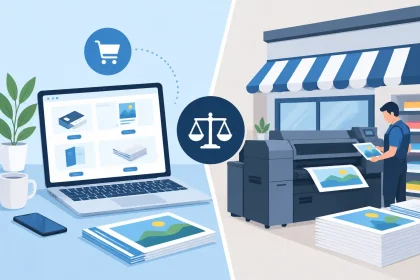
For a straightforward order, the process generally looks like this:
- You select the product, quantity and options, then request a quote or place an order.
- Your PDF artwork is uploaded and checked for production suitability.
- Once the order is confirmed, it moves into the print queue.
- The job is printed, trimmed, finished and packed.
- It is collected for courier delivery across Australia.
A deadline should be measured from the day you provide final, print-ready files, not from the day the design first goes to your designer. That distinction can save a lot of last-minute stress.
What affects printing turnaround time?
The type of product you choose
Standard flat products are often the fastest to produce. Business cards, flyers, letterheads, envelopes and simple promotional cards usually involve a more direct production path than products requiring several finishing stages.
Other products naturally need more handling. Pull-up banners require accurate printing at a larger format, trimming and assembly into the banner base. Drink coasters may need specific stock and finishing processes to achieve the durability and absorbency hospitality venues expect. Fridge magnets require magnetic backing and careful finishing. None of this is a reason to avoid these products – it simply means they should be ordered with a little more lead time.
Size matters as well. A small batch of A5 flyers and a large format display graphic do not use the same equipment, materials or finishing workflow. If timing is critical, share your deadline before choosing a product specification so the right option can be considered from the start.
Quantity and finishing choices
Higher quantities can take longer, particularly when they need to be scheduled alongside other production work. However, quantity is not the only factor. The finishing choice may have a greater impact than the number of pieces.
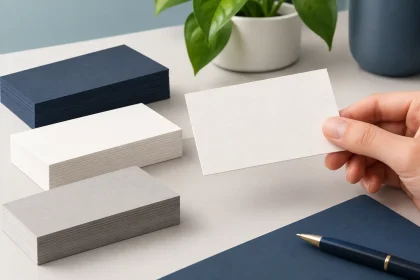
A standard business card on quality stock may be comparatively quick to process. Add folding, scoring, rounded corners, lamination, special cuts, variable details or other customised features, and extra production stages are involved. These finishes can make your collateral feel more premium and memorable, but they are best chosen with enough time up your sleeve.
There is a practical trade-off here. If the job is for an immediate event, a clean standard format may be the best route to professional print on time. If it is for an ongoing brand rollout, the extra time for a distinctive finish can be a worthwhile investment.
Artwork readiness
Artwork is one of the biggest variables in how long printing takes. A press-ready PDF with the correct dimensions, bleed, safe margins, high-resolution images and suitable colour setup gives the print team a strong starting point. It reduces back-and-forth and helps keep the order moving.
Common problems include low-resolution logos, text too close to the trim edge, missing bleed, incorrect page sizes and artwork exported in a format not suited to commercial printing. These are fixable issues, but each one can add time if the original designer needs to make changes.
It is also worth checking the details that are easy to overlook. Is the mobile number correct? Has the venue address changed? Is the offer end date accurate? Are all names and email addresses current? Reprinting because of a typo costs more time than taking a few careful minutes before upload.
Approval timing and production cut-offs
A job cannot move ahead while it is waiting for customer confirmation, a corrected file or a final proof decision. The earlier artwork is uploaded and approved on a business day, the more likely it is to enter production sooner. Orders finalised late in the day, over weekends or around public holidays may not begin processing until the next business day.
This matters most when a deadline is fixed. A property launch, trade show, restaurant opening or local sponsorship event does not move because the print is delayed. Build approval time into the schedule, especially where several people need to sign off on the design.
Printing time is only part of the deadline
It is tempting to count the production days and stop there. In reality, the complete timeline includes design, file checks, approval, printing, finishing, packing and freight. A printed order can be ready to leave production yet still need courier time to reach Brisbane, Perth, Melbourne, a Sunshine Coast venue or a regional business address.
Weather disruptions, peak freight periods and public holidays can affect delivery networks. Major campaign periods and end-of-year events can also create busier production schedules. If your printed material must be in hand for a particular date, aim for delivery at least a few business days before the event rather than scheduling it to arrive the morning it is needed.
That buffer gives you time to inspect the order, distribute flyers to staff, load pull-up banners into the car or prepare menus and coasters for service. It turns delivery into a manageable part of the plan instead of a gamble.
How to get your print order faster
The fastest orders are usually the best prepared ones. Start with final copy and approved branding before you choose your print options. Supplying one clean, correctly exported PDF is far more efficient than sending multiple versions with instructions such as “please use the latest one”.
Choose a standard size and finish where speed is the priority. Keep quantities realistic for the immediate need, then plan a larger follow-up run if the campaign performs well. For example, an event organiser may print enough flyers and pull-up banners for the first activation, then reorder collateral once dates and messaging are confirmed.
Be clear about your required delivery date when requesting a quote. A print partner can give more useful guidance when they understand whether the job is needed for a meeting next week or a conference next month. If your files need attention, addressing that early is the quickest way to keep the job on track.
For businesses without in-house design support, asking for help before placing a time-sensitive order can prevent avoidable delays. A quick artwork conversation may be enough to identify whether the file is ready or needs adjustment.
When should you place your order?
For routine business collateral, ordering before stock runs low is the simplest approach. Keep an eye on business cards, letterheads, envelopes and flyers before the last box is opened. Reordering with time available gives you greater choice on stock, finishing and delivery without needing to compromise.
For campaigns and events, work backwards from the date the material must be used. Allow time for the design to be finalised, internal approvals, production and delivery, then add a buffer. Larger events, custom formats and orders heading outside major cities deserve more breathing room.
If your deadline is tight, do not guess. Contact the print team with the product, quantity, artwork status and required date. At iPrint Media, direct support can help you understand the practical options, whether you have a press-ready PDF or need a hand getting the artwork into shape.
The best print timeline is not the shortest possible one. It is the one that gets professional, brand-ready collateral into your hands early enough to use it with confidence.