A customer may meet your business at a counter, a trade table, in their letterbox or after a referral. Marketing collateral gives that moment a professional shape. A well-made business card, flyer or branded letterhead does more than display a logo – it tells people you are organised, established and ready to do business.
For Australian businesses competing for attention locally, printed materials remain one of the most direct ways to put your brand in customers’ hands. The right pieces can start a conversation, make an offer easier to remember and keep your details close when someone is ready to act.
What marketing collateral should do for your business
Marketing collateral is any branded material used to support sales, promotion and customer communication. It includes everyday essentials such as business cards, envelopes and letterheads, as well as campaign pieces like flyers, pull-up banners, drink coasters and fridge magnets.
The best collateral has a job to do. A café coaster might promote a weekday special while customers are already sitting at the table. A real estate agent’s magnet can keep their phone number on the fridge long after an inspection. A pull-up banner can help an exhibitor look established from across a busy event floor.
That is why choosing print is not simply about adding your logo to every available product. Start with the action you want the customer to take. Do you need them to call, visit, book, scan a QR code, ask for a quote or remember your name? When the purpose is clear, the format, message and quantity become much easier to decide.
Build a practical marketing collateral mix
Most small businesses do not need a large catalogue of printed products. They need a focused mix that matches how customers find, meet and buy from them. A professional services firm may get more value from premium business cards, letterheads and envelopes than from promotional flyers. A venue running regular events may need coasters, posters and banners that can be updated around a changing calendar.
Start with the everyday essentials
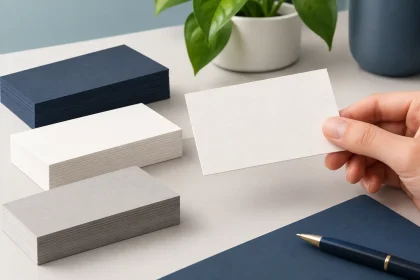
Business cards remain a practical networking tool because they make contact details easy to share without relying on a flat mobile battery, a missed email or a forgotten search later. Quality stock, sharp text and clean finishing matter here. Your card is often handled close up, so flimsy material or a crowded layout can weaken an otherwise strong first impression.
Letterheads and branded envelopes bring consistency to formal communication. They are especially useful for accountants, consultants, medical practices, trades and property professionals sending proposals, statements, contracts or welcome packs. Even when much of your communication happens online, a physical document can make important correspondence feel considered and credible.
Use promotional print where people can act on it
Flyers work best when they carry one clear offer or message. A new menu launch, seasonal sale, local opening, service package or event date all suit a flyer because the reader should understand the point quickly. Keep the headline prominent, include only the information needed to respond and make the next step obvious.
Fridge magnets suit businesses customers may need unexpectedly or repeatedly. Think plumbers, electricians, takeaway venues, vets, childcare providers and local service operators. Their strength is staying power. The trade-off is that magnets are usually most effective when your details and service are simple to understand, rather than when you have a long campaign message to explain.
Pull-up banners are built for visibility in places where people are moving: reception areas, conferences, markets, showrooms and event venues. They should be readable from a distance, which means less copy than many businesses first expect. One strong image or brand element, a short benefit-led message and clear contact details will usually outperform a banner packed with every service you offer.
Make hospitality collateral earn its space
For bars, cafés, restaurants and event spaces, printed items are already part of the customer experience. Branded drink coasters can reinforce your identity while promoting a special, upcoming event or social media handle. They need to look good, but they also need to cope with real use, including condensation and busy service periods.
The key is to give each item a purpose beyond decoration. A coaster can point customers to a function enquiry, loyalty offer or limited-time menu item. A table flyer can promote live music on Friday nights. When the offer changes often, print smaller runs more regularly rather than storing stacks of dated material in the back room.
Good design makes print easier to use
A polished design does not need to be complicated. In fact, print usually performs better when the message is simple. Give the key information room to breathe, use colours that fit your existing brand and choose type that remains readable at the final printed size.
Before sending artwork, check that contact details are current, web addresses are correct and any QR code works from a printed proof. If you are promoting a deadline, price or offer, check it once more. Reprinting because of an outdated phone number or incorrect date costs more than taking five extra minutes before approval.
For print-ready files, a high-resolution PDF is generally the safest option. Images pulled from social media or screenshots from a mobile often do not have enough resolution for crisp print, particularly on larger formats. If you are unsure whether your artwork is suitable, getting support before production can prevent disappointing results and delays.
Choose quality where customers will notice it
Budget matters, especially when you are ordering for a campaign or stocking multiple locations. But the cheapest option is not always the best value if it leaves a poor impression or needs replacing sooner than expected. Consider where and how the item will be used.
Premium business cards are worth considering when you meet prospects face to face. Durable coasters are sensible for high-turnover hospitality venues. A pull-up banner needs a clear print finish and reliable hardware if it will travel between events. For short-lived letterbox promotions, a straightforward flyer stock may be exactly right.
The goal is not to overspend on every item. It is to match the material, finish and quantity to the job. That gives you a professional result while keeping control of your marketing budget.
Plan quantities around real demand
Ordering too few can leave your team without materials at the worst time. Ordering too many can mean throwing out stock after a phone number, staff member, price list or campaign changes. Look at your actual usage over the past few months and factor in upcoming events, seasonal peaks and new locations.
For evergreen items such as business cards, branded envelopes and general service flyers, larger quantities may offer better value if your details are unlikely to change. For dated promotions, event-specific signage or menus, smaller runs can reduce waste. It depends on how stable the message is and how quickly your business moves.
It also helps to keep a simple print checklist for each order: product, quantity, delivery date, campaign purpose, final artwork version and the person approving it. This is particularly useful when several staff members handle marketing or when an event deadline cannot move.
Keep the ordering process moving
Print should support your deadline, not become another task sitting in your inbox. Have your artwork, quantities and delivery details ready before ordering or requesting a quote. If you need help, explain where the item will be used, when you need it and whether the artwork is final. That gives the print team the information needed to recommend a practical option.
At iPrint Media, businesses can upload press-ready PDF files or ask for help when an artwork file needs attention. That combination is useful whether you have an in-house designer, a freelance creative or a logo and a rough idea that needs checking before print.
The strongest printed pieces are the ones customers keep, use and remember. Choose marketing collateral with a clear purpose, make it easy to read and give it the quality your brand deserves. When the next customer picks it up, your business should feel ready for them.